
10 Seater Jet: Cost, Options & How to Fly Smarter with Memberships


Most people assume a 10-seater jet means writing a $25 million check. That's one way to do it. But buying an aircraft outright is only one of four access models available in 2026, and for most travelers, it's the most expensive per flight hour. This guide is designed for business travelers, families, and small groups seeking efficient, cost-effective, and flexible private jet solutions. Understanding your options for 10-seater jets matters because it can lead to significant cost savings, greater flexibility, and improved group travel efficiency. Whether you're coordinating executive travel, planning a family holiday, or organizing a team offsite, knowing the real models, real costs, and membership-based alternatives can put 8-10 seat private jets within reach for a flat annual fee.
Key Takeaways
A "10 seater jet" typically refers to midsize or super-midsize jets seating 8-10 passengers, capable of flying 3-6 hours nonstop.
New 10-seat private jets cost $20-30M; annual ownership runs $500,000 to over $1M before you log a single flight hour.
Charter rates for these aircraft range from $9,000-$12,000/hr (super midsize) to $12,000-$18,000/hr (heavy jets).
Specific models include the Bombardier Challenger 350, Gulfstream G200, Cessna Citation XLS+, and Embraer Praetor 600.
Hoppyn's $997/year membership provides access to empty leg flights on 8-10 seat aircraft worldwide with no per-flight cost.
What Is a 10 Seater Private Jet?
A "10 seater jet" refers to private jets certified to carry roughly 8-10 passengers plus two crew members (pilot and co-pilot). In practice, many of these cabins are configured for 8-10 adults depending on layout choices: club seating arrangements, belted lavatories, or bench seats that push the count from 8 to 10.
These business jets fall into midsize jets, super midsize jets, or entry-level large cabin jet categories. You won't find very light jets or standard light jets here; those top out at 4-7 seats and lack the cabin volume for a group of 10. The 10-seater sits in a different class of aircraft entirely.
Markets for private jets include leisure and business travel sectors, and 10-seater jets serve both well. Corporate executives and small teams use them for coast-to-coast strategy trips. Families book them for holiday travel. Sports groups, entertainment teams, and last-minute business calls fill the rest of the demand. Flying private reduces overall travel time because private jets eliminate lengthy commercial check-ins and security lines, while also improving safety by limiting exposure to crowded terminals and other time-consuming commercial processes.
10 Seater Jet Categories: From Midsize to Heavy
This section is a high-level comparison, not a spec sheet. The goal is to show where 10-seater jets sit in the broader business jet hierarchy.
Light jets seat 4-7 passengers with a range of roughly 1,500-2,500 nautical miles. Midsize jets stretch that to 6-9 seats and 2,500-3,000 nm. Super midsize jets are the sweet spot for true 10-seat capacity: they typically accommodate 10-11 passengers, with broader cabins, stand-up headroom, and ranges reaching 3,400-4,200 nm. Heavy jets can seat 10 to 14 passengers comfortably, but they cost more to buy, operate, and charter.
Most 10-seater jets fall into one of three sub-categories:
Upper midsize jets (8-9 seats)
Super midsize jets (8-12 seats)
Entry-level large or heavy jets (10-14 seats)
Long-range jets that seat 10 usually fall into super midsize or large jet categories, enabling transcontinental flights and some transatlantic missions. But seat count alone doesn't tell the full story. Cabin volume, baggage capacity, and range determine whether an aircraft actually works for your group on a given route.
Popular 10 Seater Jet Models and Their Capabilities
Here are real-world 8-10 seat aircraft actively traded and chartered in the business aviation market as of September 2026.
Model | Seats (Typical Layout) | Range (nm) | Cruise Speed (knots) | Notes |
|---|---|---|---|---|
Bombardier Challenger 300/350 | 8-10 | 3,100-3,400 | ~470-530 | Flat-floor cabin, ~7.2 ft width |
Gulfstream G200 | 8-10 | 3,400 | ~470-510 | Spacious, quiet cabin; strong resale |
Cessna Citation XLS+ | 8-9 | 2,100 | ~430-460 | Regional workhorse; lower acquisition cost |
Embraer Praetor 600 | 9-12 | ~4,018 | ~460-530 | Modern interiors; longest range in class |
Hawker 800XP/900XP | Up to 13 | 2,600-2,900 | ~430-470 | Often marketed as 10-passenger; older, lower price |
The Gulfstream G200 has a range of 3,400 nautical miles, making it a solid pick for coast-to-coast U.S. trips. The Hawker 800XP can carry up to 13 passengers in high-density layouts, though most operators configure it for 8-10 for comfort. The Praetor 600 stretches range beyond 4,000 nm in lighter-load conditions, putting certain transatlantic routes within reach.
The distinction that matters most: the Citation XLS+ handles short-to-mid-range regional hops well but won't cross an ocean. For long-range missions, you need a Praetor 600, Challenger 350, or a dedicated long-range jet category aircraft like the Falcon 7X or Gulfstream G550.
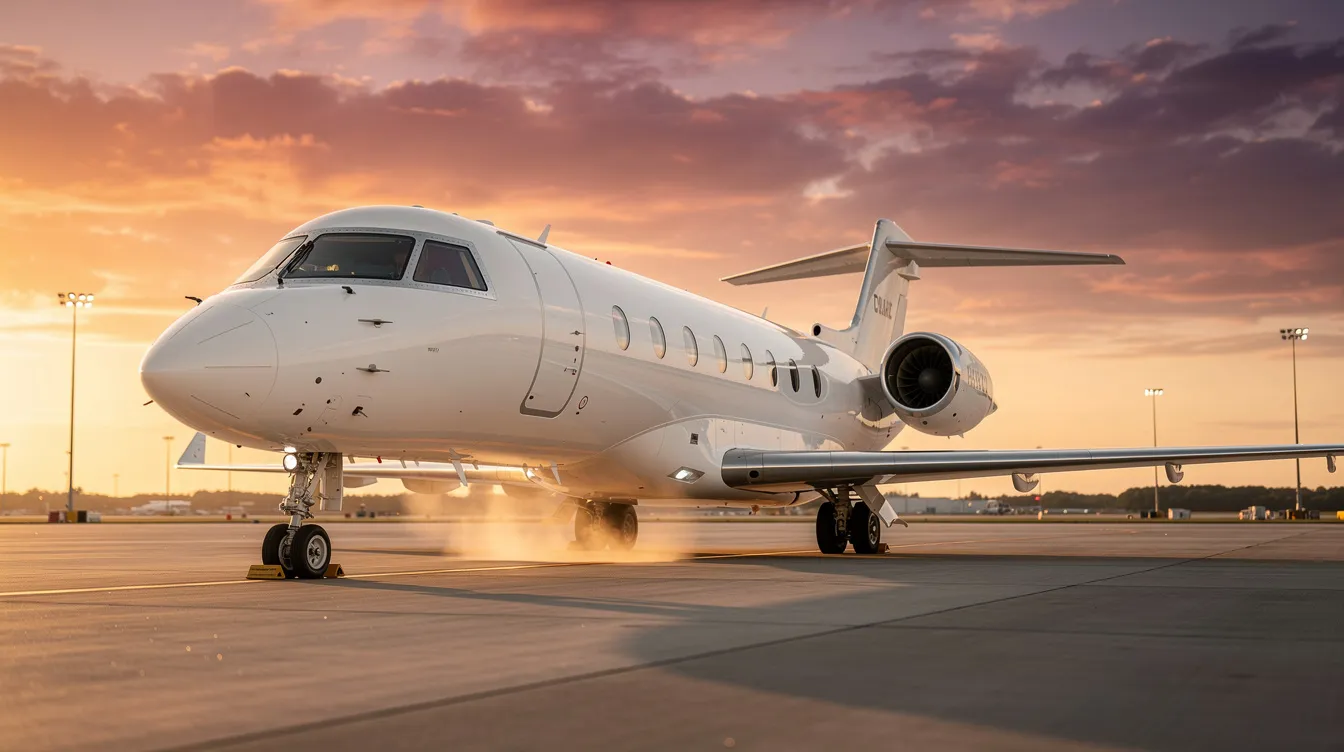
Cabin Comfort, Wi Fi, and Layout in a 10 Seater Jet
Cabin experience is the primary reason travelers step up from light jets to 10-seat aircraft. Private jets provide a high level of luxury and comfort that scales with cabin size; a super midsize jet with 10 seats offers a fundamentally different experience than a 6-seat light jet.
Typical layouts include:
Double club seating for 8, with an extra bench or belted lavatory seat to reach 9-10
Forward or aft galley (some operators offer gourmet meals on longer flights)
Enclosed lavatory at the rear
Stand-up cabins allow passengers to move around comfortably, especially on flights over three hours. Baggage capacities in jets at this size accommodate multiple suitcases and bulky items; most super midsize jets hold 100+ cubic feet of luggage.
Amenities on 2026 aircraft include Wi‑Fi (Ku-band or Starlink connectivity), and many cabins are equipped with advanced connectivity that supports productive work in flight, along with LED mood lighting, sound-insulated interiors, and lie-flat seats on overnight missions. Quiet private environments in jets enhance productivity during flights; two-thirds of private jet passengers report increased productivity compared to commercial. Frequent flyer groups benefit from the privacy of a dedicated cabin, and in-flight environments can facilitate confidential discussions and strategy meetings without the risk of being overheard.
Range and Performance: How Far Can a 10 Seater Jet Fly?
The range of 10-seater jets typically spans transcontinental distances. Midsize models cover 2,100-3,000 nm; super midsize and long-range jets push that to 3,400-4,200+ nm. The Falcon 900 series can fly 4,000 miles nonstop, and ultra-long-range jets like the Bombardier Global 6000 or Gulfstream G550 exceed 6,000 nm.
Concrete route examples:
New York to Los Angeles (~2,450 nm): a Bombardier Challenger 300 handles this nonstop in about 4.5 hours
London to Dubai (~3,200 nm): requires a longer-range super midsize or large jet
São Paulo to Buenos Aires or Miami: certain midsize jets cover these South America and Central America corridors nonstop
Cruise speed for most 10-seater jets falls between 430-540 knots, depending on altitude and weight. Actual performance on any route depends on passenger count, fuel load, and wind. Private jets access 10 times more airports than airlines, which means you can reach more destinations closer to where you actually need to be and skip ground transportation to a distant hub. Private jet travel allows for multiple stops in one trip, something commercial airlines rarely accommodate without layovers. Corporate travel can generate significant time savings with private jets by combining shorter runway access with flexible scheduling.
What Does a 10 Seater Jet Cost to Buy in 2026?
Purchase price depends on age, total flight hours, maintenance program enrollment (Rolls-Royce CorporateCare, Honeywell MSP Gold, ESP Gold), avionics vintage, and interior condition.
Price brackets for 2026:
New super midsize 10-seater jets: $20-30 million. New super midsize jets cost between $20 million and $30 million depending on the manufacturer and options selected.
Pre-owned 10-seater jets (early 2000s-2010s): pre-owned 10-seater jets typically range from $15 million to $30 million, though older models without current inspection status or with engines due for overhaul can dip into single-digit millions.
Ultra-long-range jets seating 10-14 (Falcon 7X, Global 6000, Gulfstream G550): $25-60M+ new; late-model pre-owned often in the $20-40M range.
Bespoke interiors, updated avionics packages (FANS 1/A+, WAAS/LPV), and satellite connectivity (Ku-band, Starlink) add materially to the price. A fully outfitted Praetor 600 with Starlink and a custom interior can push past $28 million new list.
Annual Ownership Costs for a 10 Seater Jet
Ownership costs for the annual operation of a 10-seater jet split into two buckets: fixed (whether you fly or not) and variable (per flight hour).
Fixed annual costs include:
Crew salaries and recurrent simulator training (captain + first officer)
Insurance (hull and liability)
Hangar and parking
Mandatory inspections and calendar-based maintenance
Variable costs include:
Fuel (Jet-A averaged $8.31/gallon in the U.S. as of August 2026)
Engine reserves and maintenance reserves
Landing and handling fees
Catering and ground transportation for passengers
Yearly operating costs for a 10-seater jet range from $500,000 to over $1 million, depending on utilization and whether engines and APU are enrolled in hourly cost programs. A midsize jet burning 200-250 gallons per hour spends roughly $1,800-2,000 per hour on fuel alone.
Jets typically depreciate by 5% to 10% annually. Over a five-year window, expect total depreciation of 30-50% of the purchase price. Factor that into any ownership calculation alongside operating expenses.
Ownership vs Charter vs Fractional Ownership vs Membership: Which Model Fits a 10 Seater Jet User?
Four ways to access a 10-seater private jet exist in 2026:
Own a private jet
Charter on-demand
Buy fractional ownership
Join a private jet membership that connects you to empty leg flights
Ownership works best for flyers regularly exceeding 200-300 hours per year. You get maximum control and availability but need capital and willingness to manage a complex asset. Membership models in private aviation can provide flexible access to jets for everyone else.
Charter means you pay per trip. Private jet rental prices depend on hourly rates for the entire aircraft: typically $9,000-$12,000 per flight hour for a super midsize, and $12,000-$18,000+ for heavy jets on international routes. No long-term commitment, but the cost adds up fast for frequent travelers.
Fractional ownership is a hybrid. You buy a share of a fleet (1/16 or 1/8), receive a set number of flight hours per year, and pay acquisition cost plus monthly management and occupied hourly fees. It sits between full ownership and charter in terms of commitment and cost.
Memberships and empty legs replace per-hour charter fees with a flat membership fee. Memberships often provide access to empty-leg flights, which are repositioning flights that would otherwise fly empty. For travelers who can flex on timing and routing, these programs make private jet access more accessible than standard charter rates, especially with membership-based empty leg flights from major hubs like Toronto.

How Empty Leg Flights Make 10 Seater Jets Affordable
An empty leg is a repositioning flight a private jet must make without passengers. After dropping clients in New York, for example, the jet might fly empty to Miami to pick up the next charter. Using empty-leg flights can make private travel more affordable because operators are recovering partial cost on a flight that would otherwise generate zero revenue, while charter companies can use operator resources to list and manage these empty legs efficiently.
Concrete examples of empty legs on 10-seater aircraft:
A super midsize Bombardier Challenger repositioning from Los Angeles to Dallas after a one-way charter
A Gulfstream G200 flying empty from London to Geneva between back-to-back bookings
Advantages:
Deep discounts vs. on-demand charter (operators want to recoup fuel and crew costs)
Private jet members can share flights to save money; your group fills seats at no extra per-seat charge
Flexibility in scheduling allows flights to adapt to last-minute changes in operator plans, and some programs concentrate empty-leg supply into city-focused hubs where you can grab spontaneous one-way deals
Trade-offs:
Routes and dates are fixed by the operator
Limited advance notice (often days, sometimes hours)
Schedule changes if the primary charter shifts or cancels
Hoppyn Membership: Access 10 Seater Jets via Empty Legs
Hoppyn is a subscription-based private jet membership focused on global empty leg flights, not traditional per-hour charter. Here is how it works:
Members pay a flat annual fee of $997/year
Members browse and join waitlists for available empty leg flights on light jets, midsize jets, super midsize jets, and some larger aircraft
Once a seat is confirmed, there is no additional flight cost; no per-leg fees
Hoppyn doesn't sell fractional ownership or aircraft shares. It sells access to an underused inventory of private jets that would otherwise fly empty. Private jet membership can reduce travel costs to a level most travelers haven't considered possible.
For 10-seater jet seekers specifically:
You may regularly see 8-10 seat midsize and super midsize jets (Bombardier Challenger, Gulfstream G200, Cessna Citation XLS+, Embraer Praetor 600) in the empty leg feed
You can bring your group at no incremental per-seat cost once you secure a flight
Travel memberships can support groups with tailored services during flights. New empty-leg routes are added daily across North America, Europe, the Middle East, Asia, and beyond, reflecting broader business aviation industry activity. Pricing is transparent: one annual fee, no hidden flight charges. Members get 24/7 support to understand routes and aircraft types.
Using Hoppyn in Practice for 10 Seater Jet Trips
Here's how a typical user interested in a 10-seater jet would use Hoppyn, step by step:
Join the membership online
Log in to browse current empty leg flights
Filter by region, dates, and approximate seat count
Join a waitlist for a suitable 8-10 seat jet
Receive confirmation when a flight is secured
Fly with your group at no additional flight cost
Members can access private terminals for enhanced convenience, skipping the main commercial terminal entirely. Membership programs allow booking flights with less notice than traditional charter, since the aircraft is already scheduled to reposition.
Flexibility is the key variable. Members who can adjust departure times or leave from a nearby airport see the biggest benefit. Short-notice planners can grab last-minute long-range jets and heavy jets when those flights appear as empty legs.
Example trip scenarios:
A team of 8 flying on a midsize jet from New York to Miami for a quarterly offsite
A family group of 6-9 on a super midsize jet from London to Ibiza or Geneva during school holidays
Entrepreneurs piggybacking on transatlantic empty legs when long-range jets reposition between Europe and North America

Is a 10 Seater Jet Right for You?
The decision comes down to four factors:
Group size: traveling solo favors different options than groups of 6-10
Mission profile: short hop, coast-to-coast, or intercontinental long-range
Budget: ownership, charter, or a private jet membership like Hoppyn
Schedule flexibility: critical if relying on empty legs
For many travelers, a mix works best: commercial airlines for routine trips, empty leg private jet via Hoppyn when the right route appears, and occasional charter for must-make meetings where the schedule can't flex. A 10-seater jet strikes the ideal balance between cabin space for a group and operating efficiency for the operator.
If you don't fly 200+ hours per year and don't want to commit tens of millions to an aircraft, ownership and fractional ownership are hard to justify. A $997/year membership gives you a seat in the same cabin without the same financial exposure.
Ready to see what's flying empty near you? Join Hoppyn and start browsing 10-seater private jet options in your region today.
Frequently Asked Questions
How many seats are really usable on a "10 seater jet"?
Most comfortable business layouts seat 8-10 adults plus 2 crew. Some aircraft achieve the "10" count by including a jump seat or belted lavatory position that is technically a certified seat but not comfortable for flights over two hours. Before any trip, you can confirm the exact seat configuration for the specific aircraft assigned. Flight attendants may or may not be present depending on the operator and mission length, which can also affect usable seat count.
Can I choose a specific 10-seater jet model with Hoppyn?
With empty leg flights, the aircraft type is set by the operator because the primary charter defines which jet is flying. Members can see aircraft details on each listing, including model, approximate seat count, and general range jets category. You cannot swap the aircraft for a different model on an empty leg, but that trade-off in flexibility is exactly what enables the best deal versus standard charter. You can request a flight for specific routes and let Hoppyn match you to available legs.
Are long-range international trips possible on empty-leg flights?
Yes. Ultra long-range jets like the Falcon 7X, Bombardier Global 6000, and Gulfstream G550 regularly reposition across oceans, creating empty-leg opportunities. Routes like New York to London or Geneva to Dubai do appear, though less frequently and often on shorter notice than domestic segments. Monitor the platform regularly; these legs tend to be claimed quickly.
What if my schedule can't be flexible around empty legs?
If timing and departure airport are non-negotiable, on-demand charter is more suitable than relying solely on empty legs. Many Hoppyn members keep commercial tickets or charter as a backup and treat empty legs as an upgrade when the timing works. Empty legs work best as an affordable way to add private jets into a broader travel mix rather than replacing every trip.
How do I get started with Hoppyn's private jet membership?
Four steps:
Visit Hoppyn's website
Review the How It Works page and membership details
Sign up for the annual membership ($997/year) and create your account
Start browsing available empty-leg flights immediately
New flights are added daily. The sooner you join, the sooner you can start monitoring routes that match your travel patterns and group size.
Conclusion
A 10-seater jet offers the perfect balance of space, comfort, and range for groups of 8-10 traveling for business or leisure. While outright ownership remains the most costly option, it provides unmatched control and availability. Chartering offers flexibility without long-term commitment but comes with high hourly rates. Fractional ownership blends ownership benefits with shared costs but still requires significant investment.
For most travelers, especially those with flexible schedules, private jet memberships like Hoppyn's unlock affordable access to empty leg flights on 10-seater jets worldwide. With a transparent flat annual fee and no per-flight charges, you can enjoy private jet travel without the traditional financial risk or complexity. Memberships also offer convenience, global reach, and the ability to bring your group along at no extra cost.
If you want to fly private for less, embrace the empty leg model and join a membership that puts 10-seater jets within reach. Ready to see what flights are available? Join Hoppyn today and start flying smarter on private jets.




Unlock Your Private
Jet Experience
Join our exclusive membership for
free flights today!

Explore More
Blogs


Join Our Exclusive
Newsletter
.png)






