
Private Jet Travel: How to Fly Private for Less with Empty Legs


Most people assume flying private costs $5,000 or more per flight hour. That used to be true for most travelers. Empty leg flights and membership models have changed the math, and this guide breaks down exactly how.
Key Takeaways
A private jet is a smaller dedicated aircraft for exclusive use, ranging from very light jets seating 2-5 passengers to heavy jets carrying 14 or more across intercontinental distances.
Empty leg flights are discounted private jet flights that occur when a jet repositions without passengers; travelers can save up to 75% compared to standard charter flights.
Hoppyn offers a flat $997/year membership that gives you access to global empty leg charter flights with no per-flight charges once you're confirmed on a seat.
Different jet aircraft categories (light jets, midsize jets, super midsize, heavy jets, long-range aircraft) suit different routes and trip types, from a quick hop to Las Vegas to a transatlantic journey.
Flexibility is the key trade-off: if you can adapt your travel dates and airports to match available empty legs, you can fly private repeatedly for a fraction of what traditional private charter flights cost.
What Is a Private Jet? (And Why It's Not Just for Billionaires Anymore)
A private jet is a turbine-powered jet aircraft used for non-scheduled private aviation. That covers everything from business travel and family trips to medical flights and special missions. Private jets generally carry between 4 and 19 passengers depending on the aircraft type, and they use smaller regional airfields and Fixed Base Operators (FBOs) for boarding rather than crowded commercial terminals.
Flying private versus commercial travel differs in three concrete ways. First, you control the schedule; there's no connecting through a hub or waiting for Delta Air Lines to sort out a delay. Second, private jets can access over 5,000 public-use airports in the United States alone, compared to the roughly 500 that commercial airlines serve. Third, private jet charters can reduce travel time compared to commercial flights, because you skip check-in queues, security lines, and layovers.
The barrier has always been cost. Private aviation typically prices flights based on the entire aircraft rather than individual seats. A light jet charter runs $3,500 to $5,500 per hour. But since around 2020, membership and empty leg models have opened a different path. Instead of hiring the whole airplane at full rate, you can tap into underused capacity on repositioning flights and fly private at the best prices available.
How Private Jets Are Classified: Light Jets, Midsize, and Heavy Jets
Not all jets are the same. They're grouped by size, range, and cabin space, which determines where and how far you can fly.
Very light jets seat 2 to 5 passengers and cover distances of roughly 1,000 to 1,200 miles. Models like the HondaJet and Cirrus Vision Jet fall here. Very light jets operate at low hourly rates of $1,700 to $2,200, making them the entry point for private flights. Purchase prices for very light jets run between $1.5 million and $3.5 million.
Light jets carry 5 to 8 passengers with a range of up to 1,500 miles. Think Embraer Phenom 300E, Cessna Citation CJ3+, or Pilatus PC-24. These handle popular routes like New York to Miami or Paris to Ibiza comfortably. Charter rates typically land between $3,500 and $5,500 per hour.
Midsize jets seat 7 to 9 passengers and can travel approximately 2,450 miles nonstop. The Citation XLS+, Hawker 800XP, and Learjet 60 are common examples. These work for routes like London to Athens or Chicago to Los Angeles, where you need more cabin space and the altitude capability to cruise above weather.
Super midsize jets push that range to about 3,500 miles with room for 8 to 10 passengers. Models like the Challenger 300/350 and Embraer Praetor 600 balance speed, comfort, and distance for routes that stretch across continents.
Heavy jets and long-range aircraft carry 10 to 16 or more passengers and can fly distances up to 7,000 miles nonstop. The Gulfstream G550, Bombardier Global 6000, and Dassault Falcon 8X handle transatlantic and intercontinental routes with beds, full galleys, and generous amenities.
Turboprops like the King Air 350 or Pilatus PC-12 aren't technically jets, but they're cost-efficient for distances of 600 to 1,000 miles and can land on short or unpaved runways that jets can't reach.
Private Aviation Choices: Ownership, Jet Charter, and Membership
There are four main ways to access private travel in 2024, each with different cost structures and commitment levels.
Full ownership means buying an aircraft outright. The upfront costs of purchasing a private jet can range from $1 million to over $90 million depending on the model. On top of that, operational costs for private jets include maintenance, crew salaries, and insurance, easily adding hundreds of thousands per year. Ownership of a private jet is typically financially viable for those flying 200 to 400 hours annually. For most people, that's a poor fit.
Fractional ownership and jet cards let you buy a share of flight hours. Co-ownership through programs like NetJets means you pre-pay for access to a fleet without buying a whole airplane. The catch: you still pay per hour, often face long-term commitments, and minimum buy-ins can run six figures.
On-demand jet charter offers private charter flights without long-term contracts. You pick the route, date, and aircraft type. Booking a private jet can be done through dedicated charter specialists, and platforms like Jettly provide access to over 20,000 aircraft worldwide. But you pay the full charter cost. Private jet charters offer flexibility without ownership costs, and charter flights are suitable for individuals flying under 150 to 200 hours per year.
Membership based on empty legs is where Hoppyn sits. Instead of chartering an entire aircraft at hourly rates, you pay a flat annual membership fee (around $997) and access seats on repositioning flights that would otherwise fly empty. No hourly jet charter stress. No six-figure minimums. Annual membership fees can be around $997 for unlimited flights once confirmed.
Empty Leg Flights Explained: The Smart Way to Fly Private
An empty leg flight is a repositioning segment that a jet must fly with zero revenue passengers. They occur when a jet returns empty after a booked flight, or when it needs to reposition to a new city for its next charter.
Here's a concrete example: a client books a light jet from London to Nice on 10 October. The aircraft then needs to fly empty to Milan on 11 October for its next job. That London-to-Milan segment is the empty leg. The operator has already been paid for the Nice trip and is motivated to recover fuel, crew, and handling costs on the repositioning flight.
This is why empty leg flights are discounted private jet flights. According to industry pricing data, travelers can save up to 75% on empty leg flights compared to booking the same route as a standard charter. A midsize jet empty leg from Teterboro to Palm Beach might list at $4,500 to $7,500, while the same route on a full charter could cost $12,000 to $18,000.
The trade-offs are real. Routes, dates, and approximate departure times are fixed by the operator's schedule. If the primary charter changes, the empty leg can shift or be canceled; cancellation rates run about 10 to 15%. Empty leg flights are often available on short notice, sometimes just 12 to 48 hours before departure.
For flexible travelers who want access to luxury travel at lower costs and don't mind adapting plans to match available routes, empty legs are the most cost-effective way to fly private.
How Hoppyn Uses Empty Legs So You Can Fly Private for Less
Hoppyn is a subscription-based travel club that focuses on private jet empty leg flights worldwide. The model is built on one idea: thousands of jets reposition empty every day, and travel memberships provide access to private jet flights on those segments.
Here's how it works: members pay a transparent flat fee of $997 per year. Once confirmed on an empty leg, there is no additional per-flight cost. Hoppyn aggregates light jet, midsize jet, and heavy jet empty legs from vetted charter partners into one global network, updated with new flights daily.
Members can browse and join waitlists for flights across the board. You filter by region, date, and aircraft types. When a suitable flight opens, you join the waitlist. If selected, you fly. Travel memberships often include 24/7 customer support, and Hoppyn provides dedicated member services throughout the process. Members can access thousands of aircraft worldwide through the platform's operator partnerships, while charter operators use dedicated resources to integrate their fleets and list empty legs efficiently.
Hoppyn is not selling jet charter by the hour. It's providing access to surplus capacity in private aviation, which is why pricing stays flat and predictable.
What Flying Private with Hoppyn Actually Looks Like
A typical member journey starts on the flight board. You log in, check the new empty legs added that day, and scan for routes that match your plans. You might see a light jet from York (as in New York area airports) to Miami departing in three days, or a heavy jet repositioning from London to Dubai next week, similar to the spontaneous one-way options highlighted in Hoppyn's City Hub discounted private jet flights.
You join waitlists for the routes you want. When you're confirmed, Hoppyn sends exact flight details: FBO location, departure time, and passenger manifest requirements. You can check in just 15 minutes before departure at private terminals, though most members arrive 20 to 30 minutes early to settle in.
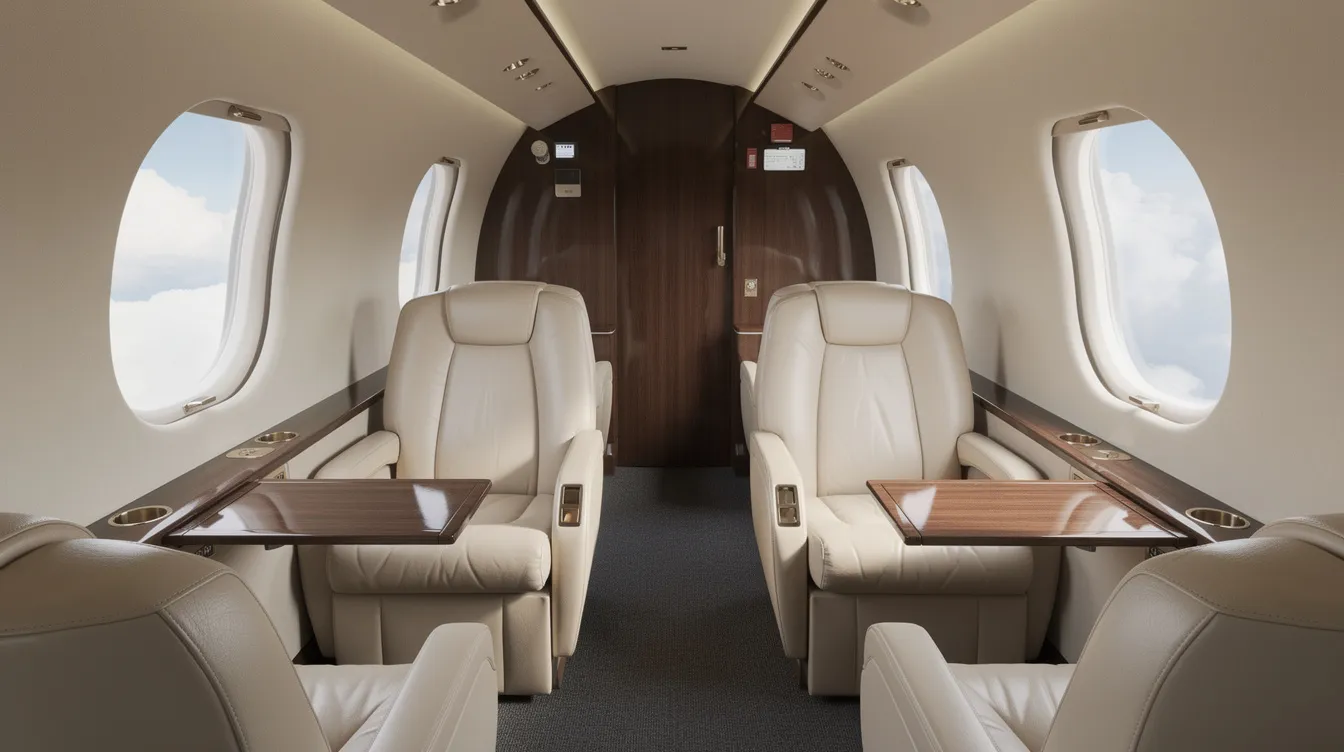
Onboard, the experience matches what you'd expect from the aircraft type. Light jets offer compact but comfortable cabins with 4 to 6 leather seats. Midsize jets add standing room, more cabin space, and often Wi-Fi. Long-range heavy jets can include full galleys, lie-flat sleeping arrangements, and generous luggage capacity. Passenger comfort scales with aircraft size.
A single membership covers unlimited confirmed flights through the year, across any available empty legs. There are no per-trip fees once you're on board.

Types of Jet Aircraft You'll See on Empty Legs
Empty legs can feature anything from a compact executive jet to a wide-cabin long-range aircraft, depending on what operators are repositioning.
Very light and light jets show up frequently on shorter routes. The HondaJet, Embraer Phenom 100 and 300, Cessna Citation Mustang, and Citation CJ2/CJ3 are common. These handle missions like Paris to Ibiza, Los Angeles to Las Vegas, or Toronto to New York. Expect 4 to 8 seats, compact lavatories, and flight lengths under three hours.
Midsize and super midsize jets appear on medium-distance corridors. The Hawker 800XP, Citation XLS+, Challenger 300/350, and Gulfstream G200 cover routes like New York to Austin, London to Marrakech, or Miami to the Caicos Islands (Turks and Caicos). These aircraft offer stand-up cabins, more amenities, and enough range for 2,000 to 3,500-mile legs.
Heavy jets and long-range models surface less often but deliver outsized value when they do. Gulfstream G450 and G550, Bombardier Global 5000 and 6000, and Dassault Falcon 7X can handle transatlantic repositioning. A heavy jet returning from Saint Martin to London, or a Global 6000 repositioning from Dubai to Singapore, gives a small group access to an intercontinental cabin at a fraction of normal air charter costs. These are the aircraft that can fly up to 7,000 miles nonstop.
Turboprops occasionally appear on the board too, suited for short regional hops to remote airports where jet aircraft can't operate.
Comparing Empty Legs vs Traditional Jet Charter
Both options use the same categories of aircraft. A Challenger 350 on an empty leg is the same Challenger 350 you'd book on a private jet charter. The difference is economics and flexibility.
Traditional charter flights give you full control. You choose the exact time, route, and aircraft. You can build multi-leg itineraries and guarantee your schedule. The cost reflects that: light jet charters run $3,500 to $5,500 per hour; heavy jets $8,000 to $14,000 or more. A private charter from New York to Miami on a light jet might cost $15,000 to $25,000 round-trip. Personalized service, custom catering, and guaranteed departure times come standard.
Empty leg flights flip the equation. You adapt to the operator's repositioning plan. In Hoppyn's case, confirmed members pay $0 per flight beyond their annual membership. The trade-off is less control over timing and routing. You cannot customize the destination or departure window.
Charter flights win for time-critical business trips, international travel with fixed meeting schedules, or when you need a specific cabin configuration. Empty legs win for flexible leisure travelers, remote workers, and anyone hunting the best prices on private travel. Booking private jets can be done instantly through digital platforms for both models.
How to Start Flying Private with Hoppyn Step by Step
Private jet chartering involves a four-stage booking process on most platforms. Hoppyn simplifies it further:
Step 1: Join Hoppyn. Sign up for the annual membership at $997/year. That fee covers global empty leg access, unlimited confirmed flights, and 24/7 support.
Step 2: Set up your preferences. Choose your preferred departure regions, typical routes (New York to Miami, London to Nice, Los Angeles to Las Vegas), usual travel windows, and aircraft size preferences from light jets to heavy jets.
Step 3: Browse and waitlist. Scan the daily updated flight board. Each listing shows the route, aircraft type, approximate departure time, and available seats. Join multiple waitlists at once to increase your chances.
Step 4: Confirm and fly. When you're selected, approve your passenger details, arrange ground transport to the FBO, and show up. That's it. No invoices, no hourly charges, no hidden fees.
Best Routes and Use Cases for Empty-Leg Private Jet Travel
Certain corridors produce empty legs more reliably than others because of how charter demand flows.
High-frequency routes: Los Angeles to Las Vegas, New York to Miami, London to Geneva, Dubai to Riyadh, and Toronto to the Caribbean (including destinations like Turks and Caicos) all generate regular repositioning flights. Seasonal patterns matter: Florida-bound legs spike in winter; Mediterranean routes (London to Ibiza, Paris to Nice) increase in summer.
Business uses: A consultant with a last-minute client meeting in another city can scan the board and grab a light jet or midsize jet that saves a full day of commercial travel. Multi-city deal roadshows and travel around cultural events like Art Basel or the Monaco Grand Prix often align with heavy charter activity, which produces more empty legs.
Leisure uses: Weekend getaways, ski trips to Aspen or Chamonix, and family holidays where you need to bring golf bags, ski gear, or baby equipment. Private flights let you avoid the luggage restrictions and long security lines of commercial travel. Some members use the platform to explore destinations of natural beauty that commercial airlines don't serve directly. Long-range opportunities: Heavy jet empty legs sometimes appear on transatlantic routes like New York to London. For a small group willing to share the cabin, these represent extraordinary value compared to booking multiple business class seats.
Even routes touching less common destinations — places across regions like Western Sahara, Burkina Faso, or South Sudan — can occasionally surface on the board as operators reposition fleet across a global network.

How to Get the Best Prices and Value When You Fly Private
Standard charter flights are priced per hour. Membership models like Hoppyn shift the focus entirely: you maximize value by using a single annual fee as often as possible.
Stay flexible. The deepest discounts on empty legs appear 12 to 48 hours before departure, especially on routes with less demand. If you can shift your trip by a day, you open up more options.
Monitor the board. Check the flight board daily. Set alerts for your favorite corridors. Attractive light jet and long-range options get claimed fast.
Travel in a small group. If three or four people share a membership's value across several trips per year, the per-person cost drops well below a business class ticket. Spreading the $997 fee across even two midsize or long-range empty-leg flights in a year delivers value that standard air charter cannot match.
Consider weather conditions and seasonal patterns. Winter produces more southbound US legs. Summer drives Mediterranean demand. Planning travel around these patterns increases your hit rate.
With Hoppyn's model, grabbing two or three flights in a year more than offsets the membership fee compared to regular charter flights or even premium commercial tickets.
Choosing the Right Aircraft Size for Your Trip
Many first-time private flyers overestimate how large a jet they need. A light jet covers most typical domestic trips more efficiently than a midsize, and the difference in fuel burn and operating costs is substantial.
Choose a light jet when: You have 2 to 6 passengers on a trip under 1,500 miles. Routes like San Francisco to Palm Springs, Rome to Ibiza, or New York to Bermuda. Light jets balance speed and efficiency for the majority of private travel missions. Lower fuel burn also means operators list these empty legs more frequently.
Choose a midsize jet when: You need to stand in the cabin, carry more luggage, or cover routes around 2,000 to 2,500 miles. Chicago to Los Angeles, London to the Canary Islands, or Miami to the Caicos Islands. Midsize jets offer more passenger comfort on flights over two hours and generally better Wi-Fi.
Choose a heavy jet or long-range aircraft when your group is 8 to 14 passengers, or you're crossing oceans. New York to London, Dubai to Singapore, or Los Angeles to Hawaii. These aircraft carry full galleys, beds, and the fuel to fly 5,000 to 7,000 miles without stopping. The distance and flight length justify the larger cabin.
On Hoppyn, you don't select the right aircraft the way a traditional jet charter broker would. Instead, you match your plans to the available empty leg flights and the aircraft types listed on the board. Aviation experts aren't needed to navigate the platform; listings clearly show the jet category, seat count, and route.
Is Flying Private with Empty Legs Safe and Regulated?
Empty leg flights use the same certified operators, aircraft, and crew that fly full-price charter missions. The airplane doesn't know whether it's carrying a charter client or an empty leg passenger; the maintenance, inspection, and crew qualification requirements are identical.
All commercial charter flights, including empty legs, must operate under strict national aviation regulations. In the United States, that means FAA Part 135 certification. In Europe, EASA rules apply. Operators undergo regular audits, and pilots must hold type ratings specific to each aircraft.
Hoppyn partners only with established operators whose fleet meets these commercial standards. Weather conditions and airspace constraints are always the captain's call; if conditions aren't safe, the flight adjusts or cancels regardless of the booking type.
Hoppyn itself is not an air carrier. It connects members with licensed air charter operators that carry full operational responsibility for each flight. Safety briefings, seatbelt procedures, and emergency protocols follow the same rules as any private charter.
Who Private Jet Membership and Empty Legs Are Best For
Ideal members:
Founders, consultants, and remote professionals who travel several times per year between major cities and can adjust trips by a day or two to match available empty legs.
Small business owners who currently buy multiple business class tickets on commercial flights and would prefer the speed and personalized service of a light jet or midsize jet when a suitable empty leg appears. Private jet charters can reduce travel time compared to commercial flights, and empty legs make that accessible at a fraction of the cost.
Leisure travelers, couples, and families who value convenience and comfort on holiday trips and don't mind planning around flexible dates to capture the best prices across the globe.
Who may not be the best fit:
Travelers needing fixed, guaranteed schedules on specific days and times regardless of aircraft repositioning patterns. If your trip depends on arriving at a precise hour for a wedding or board meeting, on-demand charter is a better tool.
Those who need a specific aircraft or cabin layout every time they fly. Empty legs offer variety, not consistency, in fleet selection.
Frequently Asked Questions
Do I pay anything per flight when I use Hoppyn?
Hoppyn's core model is a flat annual membership fee of $997/year. That covers access to eligible empty leg flights with no additional seat cost once you're confirmed. Members handle their own ground transport and meals, but there are no hidden charter fees or hourly jet costs from Hoppyn. If any taxes or regulatory charges apply (imposed by operators or airports on international routes), they're shown transparently before you confirm.
How often do new empty-leg flights appear on Hoppyn?
The board updates daily as operators upload new repositioning flights. Frequency spikes around peak travel seasons: summer in Europe, winter in the US, and around major cultural events. Routes like New York to Florida, London to the Mediterranean, and Dubai to Riyadh tend to produce recurring empty legs. Check the platform regularly or set route alerts, because attractive options can be claimed within hours of posting.
Can I bring friends or colleagues on an empty-leg flight?
In most cases, once you're confirmed on an empty leg, you can bring additional passengers up to the aircraft's legal seat and weight limits. Hoppyn requires all passenger names and IDs in advance for security and manifest purposes, especially on long-range international routes. Sharing the membership value across multiple travelers and trips is one of the most cost-effective ways to use the service.
What happens if an empty-leg flight gets cancelled or rescheduled?
Because empty-leg flights depend on the operator's primary charter schedule, they can shift or cancel if that main booking changes. Cancellation rates across the industry run about 10 to 15%. Hoppyn communicates changes promptly and helps find alternative empty legs where possible. Since no hourly jet charter was purchased, there's no per-flight financial loss to the member. Keep some flexibility in hotel and ground transport plans to accommodate potential timing changes.
How far in advance can I book an empty leg?
Many empty leg charter flights appear a few days to a couple of weeks before departure. Some long-range repositioning legs surface earlier. Members can join waitlists as soon as flights appear on the platform and may receive confirmations anywhere from 24 hours to several days before takeoff. Travelers who plan around a flexible window ("sometime between 10 and 15 November," for example) have the best chance of securing appealing routes. You can also request a flight for specific corridors you fly often.
Conclusion: Fly Private, Fly Smart with Hoppyn
Private jet travel no longer needs to be out of reach. By leveraging empty leg flights through a transparent, flat-fee membership like Hoppyn, you can significantly reduce the cost of flying private while enjoying global access to premium aircraft. The key is flexibility—being open to adjusting your travel plans to match available empty legs unlocks a world of affordable private aviation.
Whether you’re a frequent business traveler, a remote professional, or a leisure flyer seeking convenience and comfort, Hoppyn’s membership model offers a simple, cost-effective way to experience private jet travel without the traditional charter price tag. With thousands of empty-leg flights added daily and dedicated support, you’re empowered to fly private on your terms.
Ready to browse empty-leg flights? Join Hoppyn today and start flying private for less with unlimited confirmed flights on a transparent annual membership.




Unlock Your Private
Jet Experience
Join our exclusive membership for
free flights today!

Explore More
Blogs


Join Our Exclusive
Newsletter
.png)






