
Private Plane Charter Rates: What You Really Pay (and How to Pay Less with Hoppyn


Most people researching private plane charter rates see a clean hourly number and assume that's the bill. It's not. Between repositioning fees, daily minimums, crew overnights, and a 7.5% federal excise tax, the final cost of chartering a private jet can land well above what you expected. This guide breaks down exactly where every dollar goes - then shows you how empty leg flights through Hoppyn's $997/year membership can sidestep most of those costs entirely.
This guide is for travelers, business executives, and anyone considering private jet travel who wants to understand the true costs and how to save.
Key Takeaways
Traditional private jet charter costs range from roughly $1,200 to $10,000 per hour depending on aircraft type, from turboprops up to heavy jet charter and ultra-long-range models. But the hourly rate is just the starting point - the final cost includes taxes, fees, and extras that can push the total 30–50% higher.
A typical New York–Miami charter flight on a light jet runs $12,000–$18,000 one-way. That same route frequently appears as an empty-leg flight that Hoppyn members can fly for $0 flight cost - because the jet is already repositioning.
These flights occur when a private jet repositions without passengers, and empty leg flights can save travelers up to 75% on charter costs compared with standard private jet rental pricing.
Federal excise tax, landing fees, crew overnights, fuel surcharges, and handling charges all sit on top of the hourly rate in standard charters. Hoppyn members flying on empty legs don't see those individual line items.
Hoppyn charges a flat annual fee of $997, granting access to global private jet flights with no per-flight cost once confirmed - making private jet travel accessible to anyone willing to be flexible on dates and routing.
1. How Private Plane Charter Rates Are Typically Calculated
Most private jet charters are priced per hour for the entire aircraft, not per seat. Charter flights are billed by the occupied flight hour, meaning you're paying for the plane's time regardless of whether you fill every seat.
In the 2024–2026 market, expect roughly:
Turboprops: $1,200–$2,500/hr
Light and midsize jets: $3,500–$6,000/hr
Heavy and ultra-long-range jets: $8,000–$18,000/hr
But here's what catches first-timers off guard: hourly pricing is only the starting point for total charter flight cost, because billable hours include both the passenger legs and any required repositioning flights, plus daily minimums. Billable time includes both the time in the air and applicable minimum requirements.
A 1.5-hour hop from Los Angeles to Aspen on a midsize jet during ski season might actually generate 3+ billable flight hours once you factor in repositioning from a nearby base and the operator's daily minimum. Multiply that by $5,000–$7,000 per hour and a quick weekend trip lands in the $30,000–$45,000 range before taxes and fees are even discussed.
That math is why a growing number of flexible travelers skip the traditional charter process altogether and look at empty leg flights instead, often after using a charter flight cost calculator to estimate those all-in numbers before booking.
Average Private Jet Charter Rates by Aircraft Type
Aircraft type is the single biggest driver of private plane charter rates because it determines crew size, fuel burn, cabin space, and maximum range. Charter rates for private jets depend primarily on aircraft size and flight distance, and aircraft size significantly affects the hourly operational cost of private jets.
Here are typical 2025–2026 ballpark wet rates (crew, fuel, insurance included; extras not included):
Aircraft Category | Seats | Typical Use | Hourly Rate Range |
|---|---|---|---|
Turboprop / Piston | 4–8 | Short hops, smaller airports | $1,200–$3,000 |
Light Jet | 4–7 | Regional, 1–3 hr flights | $3,200–$5,200 |
Midsize Jet | 7–9 | Cross-country, domestic flights | $4,800–$7,200 |
Super-Midsize | 8–10 | Coast-to-coast | $6,500–$9,500 |
Heavy Jet | 10–16 | Long-haul flights, international | $8,500–$13,000 |
Ultra Long Range | 12–19 | Transoceanic | $12,000–$18,000+ |
Private jet charter costs range from $1,200 to $10,000 per hour across the most common categories. Hoppyn members see many of these aircraft types on the empty leg board - but without paying the published hourly charter rate.
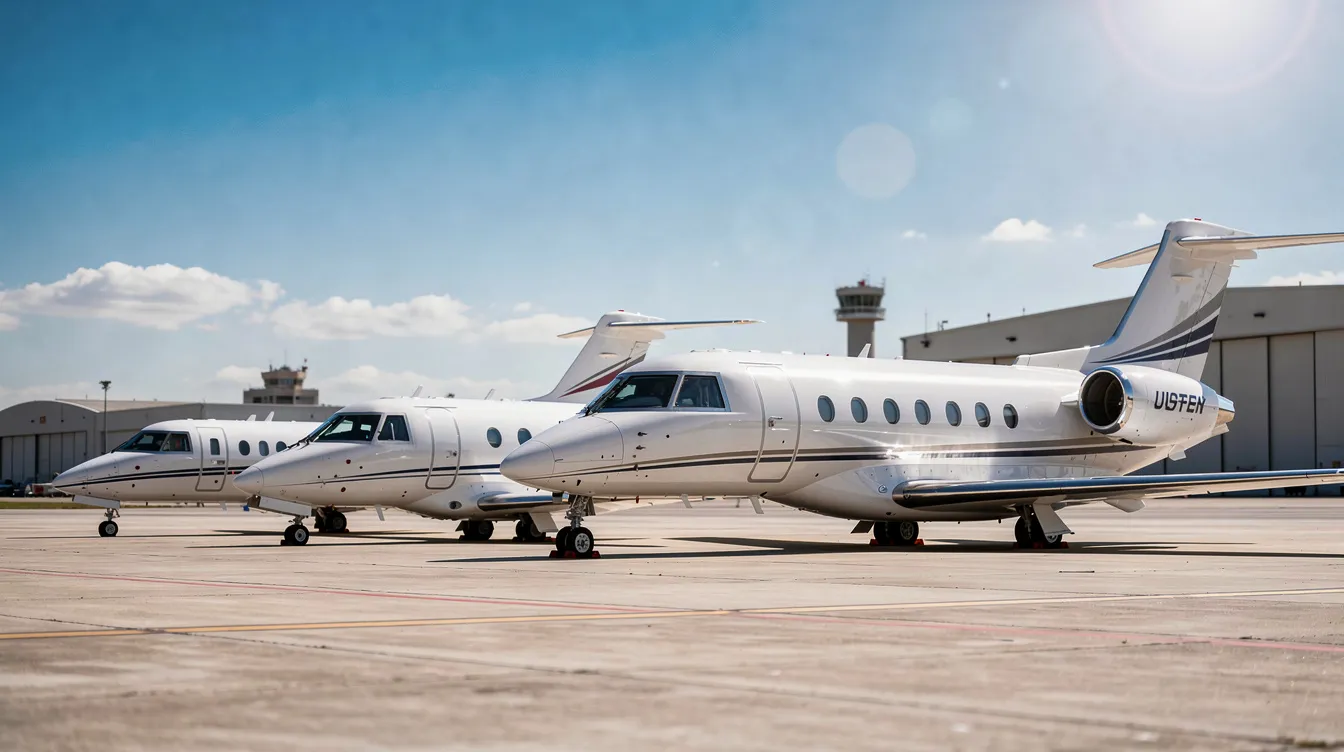
A row of various private jets, including a small turboprop and a large heavy jet, is parked on a sunlit airport tarmac, showcasing the diversity in aircraft types available for private jet travel. This scene highlights the options for private jet charter services, catering to different needs and preferences in the private aviation industry.
Turboprop & Piston Charter Rates (Entry-Level Private Jet Travel)
While not technically "jets," turboprops and pistons appear in most private jet rental searches because they're the most affordable way to fly private. Think Pilatus PC-12s for New York–Boston day trips or King Air 200s for Dallas–Houston business runs.
Turboprop charters start at around $2,000 per hour, with the broader range sitting at $1,500–$3,000 per hour depending on route and season. Piston aircraft - smaller and slower - can come in as low as $500–$1,500 per hour for very short missions.
These light aircraft can use smaller airports and regional airports that larger private jets can't access, which saves ground time. But don't assume that means lower charter costs across the board: once repositioning and minimums are added, a 40-minute turboprop hop can still bill at 1.5 hours, pushing total trip cost higher than the pure flight time suggests.
4. Light Jet Charter Rates
Light jets are the common first step into "true" private aviation for 4–7 passengers on trips of 1–3 hours - Los Angeles to Las Vegas, London to Geneva, or the busy New York–Miami corridor.
Light jets typically cost between $1,800 and $3,300 per hour for models like the Cessna Citation CJ3, Phenom 300, or Learjet 45XR. Broader market wet rates from charter operators push the range up to about $3,200–$5,200 per hour depending on the specific aircraft.
Here's a quick example calculation: a two-hour New York–Miami flight billed at 2.5–3 hours including taxi time, at $5,000/hr, puts you at $12,500–$15,000 before taxes and fees. A two-hour private jet flight can cost between $8,000 and $37,000 depending on cabin class and aircraft type.
Now contrast that with what Hoppyn members see: the same city pair regularly appears as a last-minute empty leg available through discounted private jet flights from your city hub. If your departure date is flexible, that flight cost drops to $0 beyond the annual membership fee.
5. Midsize & Super-Midsize Jet Charter Rates
Midsize jets (Cessna Citation XLS+, Hawker 800XP) and super-midsize jets (Citation X, Gulfstream G280) are the versatile aircraft of choice for 5–9 passengers or U.S. coast-to-coast private jet travel with enough cabin space to work or sleep.
Midsize jets can cost between $3,200 and $4,400 per hour at the lower end of the market, with broader ranges extending to $4,800–$7,200 per hour. Super-midsize aircraft typically run $6,500–$9,500 per hour.
A San Francisco–New York business trip on a super-midsize jet can easily hit $40,000–$60,000 round trip depending on dates and crew overnight requirements. That's a significant private jet flight cost for what amounts to two flights.
Reducing that number is possible: ultra-efficient routing, non-peak days (midweek instead of Sunday evenings), and choosing a departure airport that avoids repositioning can all noticeably reduce private plane charter rates. Or you can skip the per-hour math entirely by watching for these larger aircraft on Hoppyn's empty leg board.
6. Heavy Jet Charter & Ultra Long Range Pricing
Heavy jets (Gulfstream IV, Challenger 604) and ultra long range aircraft (Gulfstream G650, Global 6000) serve 10–16 passengers on long-haul and international flights - New York to London, Los Angeles to Tokyo, or similar missions that demand a larger aircraft with serious range.
Heavy jet charters can cost closer to $10,000 per hour, with the broader range sitting at $8,500–$13,000 per hour. Ultra-long-range jets push to $12,000–$18,000+ per hour.
Route examples make the scale clear:
New York–London on a Gulfstream G450: roughly $80,000–$100,000 one-way
Los Angeles–Hong Kong or trans-Pacific segments: ultra-long-range jets can exceed $190,000 for these missions
These aircraft do appear as empty legs when repositioning for long-haul flights, creating rare chances to experience ultra-long-range jets at a fraction of published charter rates. If you spot one on Hoppyn's flight board, it's worth acting fast.

7. Understanding "Per Hour" vs Total Trip Cost
The "per hour" figure you see quoted is only the starting point. Charter quotes frequently incorporate both fixed and variable fees, making total costs higher than just hourly rates.
Here's what inflates the bill:
Repositioning legs: If the jet isn't based at your departure airport, you pay for the ferry flight. That's often 0.5–1.5 extra billable hours at the same rate.
Daily minimums: Many operators enforce 1.5–2-hour daily minimum flight-time requirements, so a 40-minute flight still bills as 1.5 hours. Daily minimum flight-time requirements may affect total charter costs significantly on short-haul flights.
Fuel surcharge: This is a variable line item tied to fuel-price swings, and it can change as global jet fuel prices move.
Billable time includes both the time in the air and applicable minimum requirements. Consider a Chicago–Aspen ski weekend: a 2.5-hour flight on a midsize jet at $6,000/hr would be $15,000 if billed purely on flight duration. But add a 1-hour repositioning leg, a daily minimum bump, crew overnight for two nights, and a fuel surcharge, and you're looking at $28,000–$35,000. That's roughly double.
This is one of the core reasons flexible travelers look to charter options like empty leg flights - when you don't need complete control over your own schedule, the math shifts dramatically.
8. Route Distance, Time, and Peak Demand
Distance and block time are the core variables in any private jet charter cost calculation, but seasonality affects availability and pricing of private jet charters just as powerfully.
Peak periods that inflate private aviation pricing include:
Christmas–New Year travel weeks
Presidents' Day and MLK ski weekends
Art Basel Miami (early December)
Monaco Grand Prix, Cannes Film Festival
Spring Break across major U.S. corridors
Peak travel times increase private jet charter prices due to higher demand. The same Los Angeles–Aspen itinerary can cost 20–30% more in January than in April purely because of demand and slot scarcity at Aspen's single-runway airport.
The flip side: empty leg supply is often strongest when repositioning for these peak demand events. Availability of empty leg flights varies based on demand, so Hoppyn members who are date-flexible can benefit from the surge in repositioning that happens just before and after major travel weekends.
9. Charter Destination, Airport Choice & Positioning Fees
Your choice of airport has a direct effect on what you pay. Major hubs charge premium landing fees and handling rates, while nearby regional airports can cut those costs - and sometimes reduce flight time by avoiding congested airspace.
Examples that matter:
New York: Teterboro (TEB) is the go-to private aviation airport, but JFK and Westchester (HPN) can be cheaper or more convenient depending on where you're headed on the ground.
Los Angeles: Van Nuys (VNY) is the busiest private jet airport in the country, but Burbank or Santa Monica may work for smaller aircraft.
Repositioning fees apply when an aircraft needs to fly empty to reach a departure airport. If a private aircraft is based in Philadelphia and you want to depart from Teterboro, that 30–60 minute ferry leg becomes billable flight time - at the same hourly rate.
Empty leg flights are essentially these repositioning segments pre-packaged for passengers. Rather than billing you for a deadhead leg, the operator (through platforms like Hoppyn) puts those seats on the market, supported on the back end by resources for charter operators to connect fleets and list empty legs. That's the foundation of how Hoppyn works.
10. Taxes, Federal Excise Tax, and Government Fees
On top of base charter rates, U.S. domestic flights carry mandatory tax components:
A 7.5% federal excise tax applies to all domestic flights - that's on the entire charter invoice, not just the hourly rate.
Segment fees of approximately $4.50–$5.30 per passenger per leg (updated for 2026).
For international flights touching the U.S., expect international head taxes and applicable taxes for customs, immigration, and agriculture inspections. International fees can add $500 to $5,000 to charter costs depending on the route and number of passengers.
These taxes apply on top of the base charter rate and can add several thousand dollars on long or multi-leg private charters. On a $25,000 cross-country charter, the FET alone adds $1,875.
In Hoppyn's membership model centered on empty leg flights, members still travel on commercial charter operators who handle regulatory compliance. But because members are paying a flat membership fee rather than a per-flight charter invoice, they aren't calculating or remitting FET on each private jet flight themselves.
11. Airport, Handling, and Operational Fees
Traditional private plane charter invoices include a stack of operational fees that vary by location:
Fee Type | Typical Range | Notes |
|---|---|---|
Airport landing fees | $100–$1,500 per flight | Landing fees vary by airport and can significantly impact overall charter costs |
Ramp & handling | $100–$500 per movement | Ramp and handling fees can cost between $100 and $500 per flight |
Hangar/parking | $200–$1,500/night | Required for overnight stays at busy airports |
De-icing | $1,500–$15,000 | De-icing fees can range from $1,500 to $15,000 depending on aircraft size and weather severity |
Busy airports like New York's Teterboro, Miami Opa-locka, or London Luton typically charge higher fees than smaller regional fields. Reputable private jet charter services should itemize these costs in proposals so there are no surprises.
Hoppyn members don't have to analyze every fee for every flight they take - the operator absorbs these operational costs as part of the repositioning mission that's already scheduled.
12. Extras That Add Up: Crew, Overnights & Short-Leg Charges
Beyond the operational fees, several non-obvious line items inflate traditional charter invoices:
Crew overnight expenses: Commonly $200 to $600 per crew member per night. With two pilots and sometimes a flight attendant on larger private jets, a two-night ski trip adds $800–$3,600 in crew costs alone. Crew expenses can significantly add to charter costs for multi-day trips.
Short-leg fees: Operators offset heavy fuel burn and maintenance wear for flights under 45–60 minutes with surcharges, making back-to-back short sectors notably more expensive per billable flight hour.
Daily minimums: These protect owners from having jets tied up on low-revenue days. A 45-minute morning hop might bill at 1.5–2 hours to meet the minimum.
Travelers who do many brief private flights in one region - island-hopping in the Caribbean, shuttling between European cities - may find traditional charter surprisingly expensive. Flexible routing via leg flights on the empty leg board can alleviate some of that cost burden.
13. In-Flight Services, Catering, Wi-Fi & Ground Transportation
The charter cost may include additional fees such as catering and Wi-Fi, but many entry-level private jet rental quotes exclude these items entirely. Here's what to expect:
Custom catering: $230–$2,000+ per leg depending on complexity
Onboard Wi-Fi: $2–$9 per MB on metered systems; some operators include unlimited
Ground transportation: $180–$1,000+ for chauffeured cars - or a rental car if you prefer to drive yourself
Concierge services: Trip planning, restaurant bookings, and additional services vary widely by operator
If you're comparing private jet charter services, ask for an "all-in" estimate that includes these extras so you're looking at a realistic final cost. Check out our guide on the best seat on a private plane for more on what to expect inside the cabin.
On empty legs booked through Hoppyn, catering and extras are usually simpler and vary by operator - but members aren't adding thousands in base charter cost just to access the cabin in the first place.
14. Sample Route Comparisons: Traditional Charter vs Empty Leg Membership
This is where the numbers get interesting. Here are three real-world route comparisons using 2025–2026 market data.
Example 1: New York (TEB) → Miami (OPF) - Light Jet
Traditional charter pricing for a light jet on this route runs approximately $14,000–$18,000 one-way, with midsize jets pushing to $22,000–$32,000. Empty leg flights offer discounted one-way fares on this high-traffic corridor - often 25–75% below standard rates.
With Hoppyn: $0 flight cost for a confirmed empty leg, on top of the $997/year membership. This route appears regularly because it's one of the busiest repositioning corridors in the country.
Example 2: Los Angeles (VNY) → Aspen (ASE) - Midsize Jet, Peak Ski Season
Full charter in January: $25,000–$35,000 one-way. Add a return flight and crew overnights, and you're looking at $60,000–$80,000 for a weekend.
Via Hoppyn: last-minute repositioning flights to Aspen are common before and after peak weekends. Members who watch the board can hop on for no per-trip cost.
Example 3: London (Farnborough) → Ibiza - Super-Midsize, Summer
Standard charter quote: €20,000–€30,000 one-way. In July and August, demand pushes this to the high end.
Membership grants access to global private jet flights, including European repositioning legs. Catching a super-midsize heading to the Mediterranean for the summer season is entirely possible - and it comes at no additional flight cost for Hoppyn members.
15. Who Should Use Full Charter vs Empty Leg Membership?
This comes down to control versus price, with a jet card sitting between full charter and empty leg membership for travelers who want more predictable hourly pricing. Full charter buys an exact schedule and routing. Empty leg membership trades some control for dramatically lower costs.
Full charter is best for:
Executives needing fixed departure times and complete control over the booking process
Large groups with fixed itineraries and specific trip details
Travelers with specific aircraft type requirements or complex multi-leg international flights
Situations where a commercial flight isn't viable, and timing is non-negotiable
For travelers who want guaranteed availability without full aircraft ownership, a card-based membership can be a better fit.
Empty leg membership is best for:
Individuals or couples with flexible dates who want to fly private regularly
Frequent city-hoppers and digital nomads comfortable with a waitlist system
Leisure travelers who can plan around available leg flights
Anyone spending $30,000+ per year on charter who wants to reduce costs without downgrading the experience
Travelers can book empty leg flights through various platforms, but Hoppyn's flat-fee model stands apart: you're not paying discounted charter rates per trip - you're paying once per year for access. Empty leg flights can offer discounted private jet travel options but come with less scheduling flexibility, which is the core trade-off.
16. How Hoppyn's Membership Works (and Why Per-Hour Rates Don't Apply)
Hoppyn is not selling charter hours. Members pay an annual subscription - Hoppyn charges a flat annual fee of $997 - that unlocks access to global empty-leg private jet flights with $0 additional flight cost once confirmed.
Here's the core flow:
Sign up for membership at a flat rate
Browse a constantly updating empty-leg board - new empty-leg flights are added daily for members
Join waitlists for flights that fit your route and departure date window
Confirm when a seat is assigned, and fly
Because these are repositioning legs that would fly anyway, members do not shoulder traditional charter costs like hourly rates, fuel surcharges, or crew overnights. The private aircraft is already moving.
Members enjoy unlimited free flights once confirmed. The platform also provides 24/7 dedicated support for members through flight support and concierge services, and you can request a specific flight if you don't see what you need on the board.
There are no per-hour, per-seat, or hidden fees. Just transparent pricing through a flat membership - which fundamentally changes how much a private jet flight "costs" for frequent, flexible travelers.

17. Practical Tips to Reduce Private Plane Charter Rates
Whether you're booking traditional charter or flying empty legs, these strategies help keep costs down.
For traditional private jet charter:
Be flexible on departure time and airport - shifting one day or using a nearby field can save thousands
Book non-peak days (Tuesday through Thursday typically see lower demand)
Choose the smallest suitable aircraft type for your number of passengers; fuel efficiency scales with size
Avoid unnecessary repositioning legs by departing from major business aviation hubs
Ask for all-inclusive quotes to see the true cost to charter before committing
For Hoppyn membership / empty legs:
Widen your date window by even 1–2 days in either direction
Be open to nearby airports (Fort Lauderdale instead of Miami, Westchester instead of Manhattan)
Check the flight board frequently - new repositioning legs drop daily
Set up waitlists for multiple routes simultaneously to increase your odds
Use the trip planning flexibility to stack trips around seasonal repositioning surges
If you routinely spend $30,000–$100,000 per year on air charter, model how many trips you could shift to empty legs. Even replacing two or three $15,000 charter legs per year with $0 empty legs more than covers the $997 membership - and the savings compound from there.
Ready to stop paying per hour and start flying on repositioning legs that would fly empty anyway?
Join Hoppyn today for $997/year and get access to private jet travel without the private jet price tag. Browse available flights, join waitlists, and experience what private travel looks like when the math finally works in your favor.
Frequently Asked Questions
How much does a private jet really cost per hour in 2025–2026?
Most private jets price between about $1,200 and $18,000 per hour depending on whether you're in a turboprop, light jet, midsize, heavy jet, or ultra-long-range aircraft type. Light jets typically sit in the $3,200–$5,200/hr range, midsize jets run $4,800–$7,200/hr, and heavy jets can cost closer to $10,000 per hour or more. The higher end applies to long-haul, wide-cabin jets like the Gulfstream G650 or Global 6000. These are wet rates - crew, fuel, and insurance included - but they don't cover landing fees, handling, taxes, or other extras that push total trip cost higher.
Do I still pay federal excise tax if I fly on an empty leg with Hoppyn?
The 7.5% FET applies to U.S. commercial air transportation and is handled by the underlying charter operator as part of the repositioning flight's operations. Hoppyn members are not paying a per-flight charter invoice - they're paying a flat membership fee. So you're not individually calculating or remitting FET on each flight. The operator manages their regulatory obligations on their end.
Can I choose any aircraft I want with Hoppyn, like a specific heavy jet or ultra long range model?
Traditional private jet charter services allow you to request a specific aircraft from a diverse fleet. With Hoppyn, you select from the empty leg flights available at any given time, which can include light, midsize, and heavy jets across a range of operators. You're choosing from what's repositioning - not building a custom flight from scratch. That said, popular corridors frequently feature premium aircraft types, so the variety is often better than people expect.
Is flying private on empty legs less safe or less regulated than a normal charter?
Not at all. Empty leg flights are operated by the same licensed charter operators, aircraft, and crews that operate standard private charters, following identical safety and regulatory standards (Part 135 in the U.S., equivalent certifications internationally). The only difference between a chartered leg and an empty leg is pricing and seat availability - the private aviation industry applies the same oversight regardless.
How many private jet flights do I need per year to make a membership like Hoppyn worth it?
Even if you replace just one or two typical $10,000–$20,000 short-haul charters with empty leg flights, a $997/year membership pays for itself on the first flight. Frequent travelers who can be flexible around the empty leg schedule - adjusting dates by a day or two, accepting a nearby airport - usually see the most value. If you're currently spending on commercial airlines business or first class and have considered chartering a private jet, the membership makes private flights financially realistic rather than aspirational.
Conclusion
Understanding private plane charter rates reveals why the hourly price you see is just the starting point. Traditional charters add layers of fees, taxes, repositioning costs, and minimums that can quickly multiply the total trip cost. For most travelers, especially those flexible on timing and routing, empty leg flights through Hoppyn’s $997 annual membership present a smarter way to fly private. By leveraging repositioning flights that would otherwise fly empty, Hoppyn members bypass typical per-hour charter charges and enjoy global access to premium aircraft with transparent pricing and no hidden fees.
If you want to fly private without paying private jet prices, embracing empty leg memberships like Hoppyn’s is the key. The savings add up quickly, and the membership model unlocks a new level of accessibility to private aviation. Ready to experience private jet travel on your terms? Join Hoppyn today and start browsing empty leg flights worldwide.




Unlock Your Private
Jet Experience
Join our exclusive membership for
free flights today!

Explore More
Blogs


Join Our Exclusive
Newsletter
.png)






