
Private Plane With Beds: How to Sleep Comfortably on Empty-Leg Jets With Hoppyn


Travelling long distances by air can be exhausting, especially for business travellers, families, and frequent flyers who need to arrive rested and ready for their next commitment. For those who value comfort, productivity, and genuine rest on long-haul flights, the ability to sleep soundly in a real bed—rather than just a reclining seat—can make all the difference. This guide is for business travellers, families, and anyone seeking restful, comfortable sleep on long-haul private flights. Discover how private jets with beds can transform your travel experience, offering hotel-like comfort, privacy, and the chance to maximise your time in the air.
Key Takeaways
Many heavy jets, ultra-long-range jets, and VIP airliners carry full bedrooms with full-size beds, ensuite bathrooms, and soundproofing. Smaller aircraft typically offer reclining seats or convertible sleeping areas instead of separate rooms.
Hoppyn doesn't sell hourly charter. Our $997/year membership gives you access to empty leg flights, including on large cabin jets and VIP-configured aircraft where comfortable sleep is possible at a fraction of typical charter cost.
A "jet with a bedroom" can mean a fully enclosed bedroom with a door, a convertible divan that folds flat, or lie-flat seats depending on the aircraft category and interior layout.
With Hoppyn, you can browse upcoming empty legs, join waitlists, and target routes most likely to use long-range jets with dedicated bedrooms and additional amenities like showers or divans.
The rest of this article breaks down aircraft types, specific models, and practical tips so you can plan for comfortable sleeping arrangements on private empty-leg flights.
Do Private Planes Really Have Beds and Full Bedrooms?
Yes. Many heavy jets, ultra-long-range jets, and VIP airliners have full bedrooms with doors, fixed beds, and hotel-grade finishes. Most light jets and midsize jets rely on lie-flat seats or convertible sleeping areas rather than separate rooms.
The difference between these setups matters. A reclining seat tilts back and might include a footrest; fine for a two-hour hop. A lie-flat bed creates a near-horizontal sleeping surface in the main cabin. A fully enclosed space, by contrast, is a separate, soundproofed area with a full-size bed, a door, adjustable lighting, and added privacy. Private jet bedrooms often feature full-size beds specifically for passenger comfort on longer journeys.
Full bedrooms are typically found on long-range jets like the Gulfstream G650ER, Bombardier Global 7500, and Dassault Falcon 8X, as well as on Airbus Corporate Jets (ACJ) and Boeing Business Jets (BBJ). VIP airliners can provide totally customised layouts including luxury bedroom configurations tailored to the owner.
On empty-leg flights, you may access the same bed-equipped aircraft that owners or charter clients use without paying the full charter rate. The Gulfstream G700 and Bombardier Global 7500 are benchmarks for luxury in private aviation, and both appear on empty-leg boards when they reposition between missions.
One caveat: exact sleeping configuration always depends on the specific aircraft tail and its interior completion. Some owners trade the aft stateroom for a meeting room. Always verify layout before committing.
Types of Sleeping Arrangements on Private Jets
The in-flight experience for sleep ranges from deep-recline seats to full bedrooms with doors, depending on aircraft category and route length. Here are the main types:
Reclining seats: Standard on light and midsize jets. The seat tilts back with a footrest. Adequate for naps up to about two to three hours. Aircraft with convertible seating rely on recliners rather than dedicated sleeping arrangements.
Lie-flat seats and near-flat surfaces: Found on super midsize jets and some heavy jets. Seats convert electronically to create a mostly horizontal surface. Suitable for three to six hours of rest.
Convertible divans and sofas: Bench-style seating that folds out into flat beds. Common on Challenger 350s, Falcon 900 series, and similar heavy jets. Shares the main cabin with other passengers.
Fixed beds in dedicated bedrooms: Queen or king-size bed behind a solid door, often with an ensuite bathroom. Found on ultra-long-range aircraft and VIP airliners. Built for a full night's rest on intercontinental flights lasting 8 to 15 hours.
Comfort windows roughly follow aircraft size. Fully reclining seats work for short segments. Lie-flat beds cover medium-haul. Dedicated bedroom suites handle the red-eyes and transoceanic crossings where sleep quality makes or breaks your arrival state.
On many empty leg flights, cabin crew can reconfigure convertible sleeping areas after takeoff. If you plan to sleep, let the operator know ahead of time so divans or seats are prepped for you right after climb-out.
Dedicated Bedrooms vs Convertible Sleeping Areas
Dedicated bedrooms are fully enclosed spaces with fixed beds, solid doors, and built-in storage. Convertible sleeping areas are main-cabin divans or club seats that transform into flat sleeping surfaces, sharing space with other passengers.
Dedicated bedrooms offer a queen- or king-size bed, advanced soundproofing, adjustable lighting, and often ensuite bathrooms. The experience parallels a hotel room. Dedicated bedrooms on jets provide a hotel-like experience in the air, and dedicated flying suites often include features that match a luxury hotel stay. Soundproofing in private jet bedrooms enhances sleep quality, creating a sleeping environment where you can sleep soundly even at 45,000 feet. Benefits of private jets with beds include better sleep quality and increased privacy.
Convertible sleeping areas are more common. A double bed formed from two facing club seats, a divan that folds flat, or a sofa that extends. These share the main cabin, so privacy is limited to curtains at best. They work well for three- to six-hour segments where a peaceful journey matters but a fully enclosed bedroom isn't available.
When does each make sense? Private bedrooms are ideal for long red-eyes like New York to London or Dubai to London. Convertible areas handle shorter overnight segments like Los Angeles to Honolulu or Paris to Dubai.
Most empty leg opportunities will involve convertible sleeping areas. But some repositioning flights on heavy jets and VIP airliners do offer true bedrooms if you catch them. Bedroom availability depends on the tail and the route.
Private Planes With Full Bedrooms: Notable Aircraft Models
Full bedrooms and ensuite bathrooms are concentrated in specific heavy and ultra-long-range jets, plus VIP-configured Airbus Corporate Jets and Boeing Business Jets. Here are the models most likely to feature private suites:
Gulfstream G700: Certified March 2024, with deliveries in the mid-2020s. Range of approximately 7,750 nautical miles. Up to five cabin zones across a 56-foot, 11-inch cabin. The Gulfstream G700 features a full-size bed and en suite bathroom in its aft Grand Suite. Purchasing a Gulfstream G700 costs around $70 to $80 million new.
Bombardier Global 7500: In service since late 2018. Range of approximately 7,700 nautical miles. Multiple cabin zones with one of the widest cabins in its class. The Bombardier Global 7500 offers a permanent aft queen bed, often with a wardrobe and enclosed lavatory.
Gulfstream G650ER: In service since around 2014. Range of approximately 7,500 nautical miles. Many tails include an aft stateroom with a master suite and private bathroom.
Dassault Falcon 8X: Range of approximately 6,450 nautical miles. The Dassault Falcon 8X provides full beds with private lavatories, though a fully enclosed bedroom is less common than on the G700 or Global 7500.
Embraer Lineage 1000E: A VIP airliner based on the E190 airframe, with a large cabin that can support multiple bedrooms and lounge zones.
Boeing Business Jets (BBJ): Boeing Business Jets can include multiple bedrooms with king-size beds, custom showers, and conference rooms. Sleeping capacity varies by layout.
Airbus Corporate Jets (ACJ319neo, ACJ320neo): Airbus Corporate Jets often feature multiple bedrooms for delegations, with range up to approximately 7,400 nautical miles.
While these aircraft can have full bedrooms, configurations vary by owner. Some replace the aft stateroom with extra lounges. You must verify the actual layout for any given tail.
When these long-range jets appear as empty legs on Hoppyn, they offer a rare chance for members to experience a true jet with a bedroom without paying standard charter prices.

How Sleeping Comfort Differs by Aircraft Category
Each aircraft category handles sleep differently. Here's a practical breakdown:
Turboprops and very light jets (e.g., Pilatus PC-12, Cessna Citation M2)
Comfortable reclining seats, cabin height often below five feet in VLJs, no flat beds or dedicated sleeping areas. Best for short hops where sleep isn't the priority. Standard private jets are optimised for short-to-medium flights and typically lack beds.
Light and midsize jets (e.g., Embraer Phenom 300, Citation Latitude)
Deep-recline seats, occasional divans. The Citation Latitude offers about six feet of stand-up height and a divan for short naps. For details on choosing the best seat on a private plane, seat position matters as much as recline angle.
Super midsize jets and heavy jets (e.g., Gulfstream G280, Challenger 650, Falcon 900)
Multiple lie-flat seats and divans, privacy curtains, partial separation between work and sleep zones. Heavy and super midsize jets typically do not have true sleeping accommodations in the dedicated-bedroom sense, but they provide flat beds and divans for a restful journey.
Ultra long-range jets and VIP airliners (e.g., G700, Global 7500, Falcon 8X, ACJ319neo)
Dedicated bedrooms, lower cabin pressure, improved humidity, and circadian lighting. The most luxurious sleeping configurations are found in the largest aircraft categories. Ultra long-range business jets feature soundproofed multi-zone cabins with master suites. These jets reduce jet lag by keeping cabin pressure equivalent to 3,000 to 6,000 feet, and cabin pressure in private jets at this level can reduce jet lag by 20 to 30 percent. Travelers arrive refreshed because the sleeping environment on these modern jets is built for a full night's rest across multiple time zones.
Design, Technology, and Additional Amenities in Jet Bedrooms
Modern private jet bedrooms and convertible sleeping areas are engineered to deliver comfortable sleep through design, technology, and additional amenities beyond a mattress. Private jets with beds enhance sleep quality during long flights through several overlapping systems.
Cabin environment: Cabin altitude on jets like the G700 is around 4,000 to 5,000 feet, compared to 6,000 to 8,000 feet on older heavy jets and the equivalent of 6,000 to 8,000 feet on commercial flights. Private jets can maintain cabin pressure equivalent to 3,000 to 6,000 feet, which keeps blood oxygen higher and reduces fatigue. Advanced soundproofing and low cabin altitudes are features of ultra-long-range jets, and private jet bedrooms often include soundproofing and climate control for undisturbed rest.
Lighting and tech: Customizable mood lighting helps regulate circadian rhythms on jets, with LED systems that shift colour temperature to match destination time zones. Private jets allow for customizable sleeping environments with adjustable lighting, individual climate controls in dedicated bedrooms, HD screens, and high-speed Wi-Fi that let passengers work or stream before resting.
Soft products: High-thread-count linens, mattress toppers, duvets, and optional sleep kits (eye masks, earplugs) are standard on many large cabin jets. These details add up, enhancing sleep quality across six-, eight-, or twelve-hour segments.
Business travellers and families can use these features to turn long-haul flights into productive or deeply restful segments. Aircraft equipped with beds allow for increased flexibility in productivity during travel; you can work for four hours, sleep for six, and arrive refreshed enough to walk into a meeting. A business traveller seeking real rest on an intercontinental mission needs the right aircraft with these systems working together.
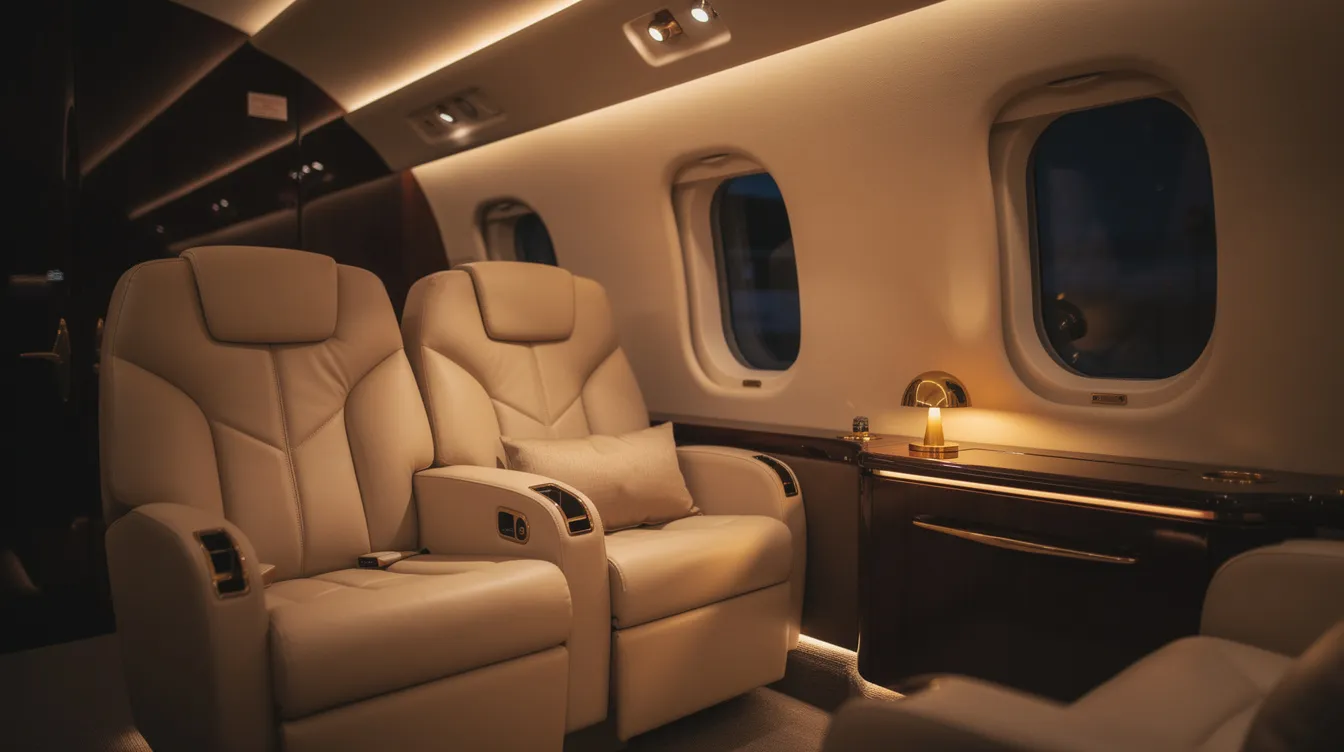
Empty Leg Flights and Accessing Jets With Beds Through Hoppyn
An empty leg flight is a repositioning flight that would normally fly without passengers. It happens after dropping off a charter client or heading to a pickup location. These flights create unique access opportunities for jets with a bedroom at a fraction of full charter cost.
Here's how Hoppyn works: a flat $997/year membership gives members access to browse and join waitlists for empty leg flights globally with no per-flight charter cost once a seat or aircraft is confirmed. Private jets offer these repositioning legs across every aircraft category, including long-range jets and large cabin jets with dedicated bedrooms or convertible sleeping areas.
Members can use route details and flight notes to target longer segments and larger aircraft more likely to feature full bedrooms or ensuite bathrooms. Ultra-long-range flights between major hubs, such as New York to London or Los Angeles to Dubai, are commonly flown by G650ERs, Global 7500s, and VIP airliners.
Because empty legs are opportunistic, flexibility on dates, times, and exact aircraft is key. But the value proposition for experiencing a private jet with dedicated sleeping areas is dramatically better than standard charter pricing, especially when you leverage spontaneous, one-way empty leg flights from your departure city. Chartering or owning a plane with sleeping suites involves significantly higher hourly rates than what you'll pay through a membership model.
How to Use Hoppyn to Improve Your In-Flight Sleep
You can use Hoppyn's platform and 24/7 support team to prioritise comfortable sleep when choosing or waitlisting empty leg flights. Here's a simple workflow:
Join Hoppyn for $997/year.
Log in and browse flights, filtering by route length and aircraft size.
Join waitlists for legs most likely flown by heavy or long-range jets.
Check flight notes or request a flight to ask about sleeping arrangements (dedicated bedrooms, convertible divans, or lie-flat seating) for specific tail numbers.
Align empty leg departure times with your usual sleep window. Bring personal sleep aids: your own pillow, eye mask, and anything else that helps you sleep soundly at home. Let the operator know you intend to sleep so the cabin crew can set up convertible sleeping areas right after takeoff, allowing passengers to settle in quickly.
Hoppyn can't redesign an aircraft interior. But our membership model makes it realistic for more people to experience aircraft categories that were once reserved for top-tier charter or ownership budgets. Many long-range jets and ultra-long-range aircraft that appear on the flight board carry dedicated sleeping areas or private suites, and members can tap into empty-leg flights from key hubs like Toronto to access these cabins at a fraction of the traditional cost.
Cost and Value: Empty Legs vs Traditional Charter for Jets With Beds
Full bedrooms and large cabin jets command the highest hourly charter rates in private aviation, especially on ultra-long-range missions. Here's what the numbers look like:
Charter rates for ultra-long-range jets start at $13,500 per hour and can climb above $16,000.
VIP airliners typically charge $20,000 to $25,000 per hour for charters.
A typical New York to London round trip on a Global 7500 costs $150,000 to $220,000.
Annual operating costs for private jets in this class can reach $4 to $10 million.
Contrast this with Hoppyn's membership: one transparent annual fee, unlimited free flights once confirmed (no hourly charges, no fuel surcharges), and the ability to catch occasional empty legs on these very same long-range jets.
Because empty legs are pre-planned repositioning flights, the economics are different. The aircraft is flying anyway. Filling seats via membership lowers the effective cost of experiencing a jet with a bedroom from hundreds of thousands of dollars to a $997 membership fee plus whatever travel costs you have on the ground, while charter operators can use dedicated resources to list and optimize empty legs so more of these flights appear on the platform.
Think of value not only as cost per hour but as arriving rested enough to go straight into a meeting, event, or family trip without losing a day to jet lag. Private jets with beds are designed for travellers needing real rest during intercontinental trips, and that rest has a concrete return. The significant difference between empty leg access and traditional charter is the gap between paying six figures per trip and paying a flat annual fee.
Planning Your Next Flight on a Private Plane With Beds
Planning around sleep turns a private flight from "just transport" into a strategic part of your schedule for business travellers and frequent international flyers.
Planning checklist:
Route length (under 3 hours vs over 6 hours)
Number of travellers needing restful sleep
Preference for full bedrooms vs convertible sleeping areas
Need for ensuite bathrooms or showers
Flexibility around departure time and airport
On flights under three hours, focus on cabin comfort and timing rather than full bedrooms. On flights over six hours, consider aircraft categories that offer an enclosed bedroom or multiple lie-flat sleeping zones for a restful journey across multiple time zones.
Hoppyn members can use alerts and frequent checks of the flight board to spot long legs on large cabin jets. Coordinate with our team if you have specific sleep needs: children, elderly passengers, or work-before-sleep patterns where you want a quiet zone forward and a sleeping zone aft.
Think of this as an ongoing strategy. With a year-long membership, you'll gradually learn which routes and operators in your usual corridor most often produce the best in-flight experience for comfortable sleep. Over time, you'll know exactly which legs to watch for.

Frequently Asked Questions
Below are practical questions about empty-leg access to jets with a bedroom, safety, and how predictable the experience can be for business travellers and families.
Can Hoppyn guarantee that my empty leg will have a full bedroom?
Because empty legs are driven by repositioning needs, Hoppyn cannot guarantee a specific interior layout. Some legs will be on jets with dedicated bedrooms; others will have only convertible sleeping areas or reclining seats. When operators share detailed cabin info (bedroom, divan, or lie-flat configuration), we pass that on in flight details or via support so you can make an informed choice before joining a waitlist. If an operator must substitute an aircraft, sleeping arrangements may change, and we'll communicate updates as early as possible.
Is it safe to sleep in a bed or lie-flat area during an empty-leg flight?
Beds, divans, and convertible sleeping areas on certified private jets are installed and tested under strict aviation regulations, including restraint systems suitable for turbulence at cruise altitude. Passengers must be in approved, belted seats for taxi, takeoff, and landing; the cabin crew will instruct when it is safe to use beds or lie-flat setups during the flight. Follow crew guidance about returning to seats if turbulence occurs, even mid-sleep.
How can I improve my chances of getting an empty leg on a long-range jet with a bedroom?
Be flexible on dates, times, and departure airports within a region. This widens the pool of possible empty legs on long-range jets and large-cabin jets. Focus on busy intercontinental corridors like New York to London, Los Angeles to Hawaii, or Dubai to Europe, where ultra-long-range jets and VIP-configured aircraft like Airbus Corporate Jets and BBJs commonly reposition. Check the Hoppyn flight board regularly, enable notifications, and contact support if you have specific sleep-focused goals so the team can flag relevant flights.
Are empty leg flights with beds suitable for families and children?
Many bed-equipped private jets work well for families. Convertible divans become shared sleeping surfaces, and dedicated bedrooms give parents or children private rest areas. Children must still use proper restraints for taxi, takeoff, and landing. Tell the operator in advance about ages and any special needs such as travel cots or extra pillows. Families using Hoppyn can plan trips around school breaks and weekends, watching for empty legs that align with vacations and longer-haul routes for comfortable sleeping accommodations.
What makes Hoppyn different from traditional jet cards or charter brokers if I care mainly about sleep?
Traditional jet cards and on-demand charter quote by the hour and aircraft category, making regular access to long-range jets with full bedrooms extremely expensive for most travellers. Hoppyn offers a single annual membership, no hourly charter cost on confirmed empty legs, and global access to a mix of aircraft, including those normally reserved for high-budget ultra-long-range missions. For travellers whose priority is arriving rested rather than controlling every timing detail, the membership-based empty leg model is a smarter way to experience high-end, sleep-optimised aircraft categories without owning or pre-buying hours. Explore Hoppyn experiences to see what's possible.
Conclusion
Flying on a private plane with beds changes the way you experience air travel, especially on long-haul routes. Whether you choose a fully enclosed bedroom or a convertible sleeping area, the comfort, privacy, and restful sleep you gain can transform your journey. With Hoppyn’s membership model, you gain affordable access to empty leg flights on premium jets equipped for quality rest—without paying the high hourly charter rates. This means you can arrive refreshed, productive, and ready for whatever comes next, all while enjoying the perks of private jet travel.
For business travellers, families, and frequent flyers alike, prioritising sleep on your flight is a smart investment in your time and well-being. Use Hoppyn to browse flights, target routes with beds or sleeping areas, and join waitlists to maximise your chances of flying in comfort.
Ready to experience private jet travel with real beds at a fraction of the cost? Join Hoppyn today and start browsing empty leg flights worldwide.




Unlock Your Private
Jet Experience
Join our exclusive membership for
free flights today!

Explore More
Blogs


Join Our Exclusive
Newsletter
.png)






